
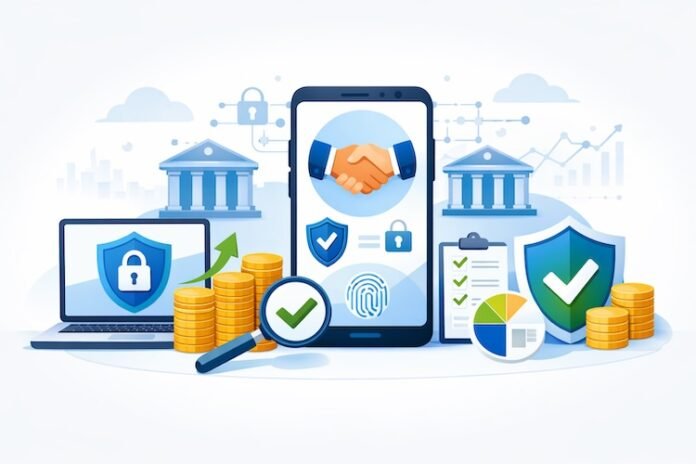

Peer-to-peer (P2P) lending has transformed how people borrow and invest money by cutting out traditional banks as middlemen. This direct connection between borrowers and lenders offers higher returns for investors than conventional savings accounts or fixed deposits. But with these attractive returns comes risk – something that kept many potential investors away in the early days of P2P lending.
Today, fintech innovations are changing the game, making P2P lending platforms significantly safer for investors.
Let’s look at how technology is creating a more secure environment for those looking to put their money into P2P lending.
AI-Powered Credit Assessment Systems
One of the biggest risks in P2P lending is borrower default. Traditional credit scoring often misses important factors about a borrower’s ability to repay. This is where artificial intelligence (AI) and machine learning are making a huge difference.
Modern P2P platforms now use AI-based credit assessment systems that analyze hundreds of data points about potential borrowers.
LenDenClub p2p lending website, for example, uses an AI-based credit underwriting model that evaluates around 670+ data points to check both a borrower’s ability and intention to repay.
These systems look beyond traditional credit scores to include:
- Transaction history and spending patterns
- Employment stability and income verification
- Repayment patterns of previous loans
- Social behavior and other non-traditional data points
The result? More accurate risk assessment that helps investors make smarter decisions about where to put their money.
Machine learning models continuously improve as they process more data, making them increasingly effective at predicting which borrowers are likely to default.
Blockchain and Smart Contracts
Blockchain technology is revolutionizing security in P2P lending by creating transparent, tamper-proof records of all transactions.
Smart contracts automatically enforce loan agreements without human intervention. This eliminates the risk of manipulation and ensures that funds only move when specific conditions are met.
The benefits for investors include:
- Complete transparency in all transactions
- Elimination of intermediaries, reducing costs and potential points of failure
- Immutable records that cannot be altered retroactively
- Automated enforcement of loan terms
Some platforms are now implementing multi-layer security with blockchain, including SSL certification and two-factor authentication to provide safe and secure access.
Also Read: New Evolution in the Financial Services Industry
Escrow Mechanisms
Perhaps one of the most important safety innovations in P2P lending is the implementation of escrow accounts. These third-party holding accounts keep investors’ funds secure throughout the lending process.
Here’s how they work:
- Investors deposit funds into an escrow account managed by a trustee (often a bank)
- The trustee acts as an intermediary between the platform and the escrow bank
- Upon receiving transaction instructions, the trustee executes the transaction after necessary checks
- The P2P platform itself has no direct access to the funds
The escrow account functions as a separate unit from the platform, ensuring complete security of both lender and borrower money.
This system creates a crucial separation that prevents misuse of funds. Money from lenders’ accounts cannot be redirected to pay off other loans, and repayments from borrowers cannot fund new loans without proper authorization.
Regulatory Compliance
The Reserve Bank of India (RBI) has implemented strict regulations for P2P lending platforms, providing an additional layer of protection for investors.
Key regulatory safeguards include:
- Mandatory registration as NBFC-P2Ps (Non-Banking Financial Company – Peer to Peer)
- Prohibition on platforms offering credit enhancement or guarantees
- Requirement that all fund transfers go through bank-operated escrow accounts
- Caps on lending amounts to prevent overexposure
- Restrictions on cross-selling products except for loan-related insurance
These regulations ensure that P2P platforms operate with transparency and fairness, protecting investors from potential fraud or mismanagement.
Risk Diversification Tools
Modern P2P platforms now offer sophisticated tools to help investors spread their risk across multiple borrowers. This diversification is crucial for reducing the impact of any single loan default.
Conclusion
Fintech innovations have dramatically improved the safety of P2P lending for investors.
From AI-powered credit assessment to blockchain security, escrow mechanisms, and regulatory compliance, these technologies are addressing the key risks that once made P2P lending seem too risky for many investors.
While no investment is entirely risk-free, these innovations have created a more secure environment where investors can confidently participate in P2P lending with better protection than ever before.
As technology continues to evolve, we can expect even more sophisticated safety measures to emerge, further strengthening the appeal of P2P lending as an investment option.