
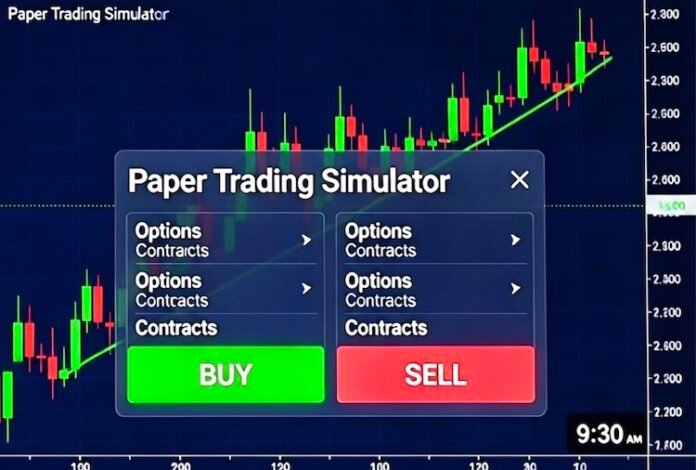

Options trading can be confusing for beginners, especially when they are learning about call options, put options, strike prices, premiums, and expiry dates. Entering the live market without understanding these concepts can expose traders to significant financial risks.
Fortunately, beginners can learn the basics through options paper trading. It allows users to practise buying and selling options using virtual money instead of risking real capital. By using a simulator, you can understand how option prices move, test different strategies, and improve your trading decisions.
In this guide, we will explain how options paper trading works, how to practise buying and selling options, and what beginners should consider before entering the live market.
What is Options Paper Trading?
Options paper trading is a simulated trading method that allows users to practise options transactions without investing actual money. Instead of placing real orders, traders use virtual funds to buy or sell hypothetical options contracts.
For example, suppose you expect the NIFTY index to move upward. You can practise buying a NIFTY call option using virtual funds and observe how its premium changes.
If the premium increases, your simulated position may show a profit. If it decreases, you may record a loss.
This process helps beginners understand options trading without exposing their savings to actual market losses. However, simulated results cannot guarantee similar performance in live trading.
Understanding Call and Put Options
Before practising, it is important to understand the two basic types of options.
1. Call Option
A call option gives the buyer the right, but not the obligation, to buy the underlying asset at a specified strike price. Traders generally buy calls when they expect the underlying asset’s price to increase.
2. Put Option
A put option gives the buyer the right, but not the obligation, to sell the underlying asset at a specified strike price. Traders generally buy puts when they expect the underlying asset’s price to decrease.
Understanding these two contracts will help you practise different market scenarios through a simulator.
How to Practise Buying and Selling Options?
Follow these steps to begin practising options trading with virtual money.
Step 1: Choose a Paper Trading App
The first step is selecting a suitable paper trading app that supports options practice.
Look for a platform that offers:
- NIFTY and BANK NIFTY options, where supported.
- Virtual funds for simulated transactions.
- Options chain with strike prices and expiry dates.
- Simulated buying and selling orders.
- Trade history and profit-and-loss tracking.
- Live or clearly labelled delayed market data.
Choose an easy-to-use platform that explains its features and limitations clearly.
Step 2: Explore the Options Chain
An options chain displays available call and put contracts for an underlying instrument. It generally includes strike prices, premiums, expiry dates, and other market information.
For example, when practising nifty paper trading, select NIFTY and explore its available options contracts.
Compare different strike prices and observe how premiums change with movements in the underlying index. Also learn about in-the-money, at-the-money, and out-of-the-money options.
Step 3: Practise Buying a Call Option
Suppose NIFTY is trading near a hypothetical level of 25,000, and you expect the index to rise.
You select a call option with a premium of ₹100 and a contract lot size of 50 units.
Your hypothetical premium value is:
₹100 × 50 = ₹5,000
You place a simulated buy order using virtual funds.
If the premium increases to ₹120, your gross simulated profit would be ₹1,000. If it decreases to ₹80, your gross simulated loss would be ₹1,000.
These figures exclude brokerage, taxes, and other charges. Actual lot sizes must be checked against current exchange specifications.
Step 4: Practise Buying a Put Option
Now consider a situation where you expect NIFTY to move downward.
You can practise buying a put option and observe how its premium responds to market movements.
For example, if you purchase a hypothetical put option at ₹100 and its premium increases to ₹115, the gross simulated profit would be ₹750 for a lot size of 50 units.
If the premium falls to ₹85, the gross simulated loss would also be ₹750.
This exercise helps you understand how put options behave under different market conditions.
Step 5: Practise Selling Options
After understanding option buying, you can explore simulated option selling if your platform supports it.
Option sellers receive premiums but take on contractual obligations. Selling options can involve substantial or potentially unlimited losses, depending on the position.
For example, a seller may receive a hypothetical premium of ₹100. If the premium falls to ₹70, the seller’s gross simulated gain would be ₹1,500 for 50 units. If it rises to ₹130, the gross simulated loss would be ₹1,500.
These examples exclude transaction costs and assume the position is closed at the stated premium. Learn about margin requirements and risk exposure before exploring option-selling strategies.
Why Use an Options Trading Simulator?
An options trading simulator provides a learning environment where beginners can understand market mechanics without risking actual trading capital on simulated orders.
Some important benefits include:
- Practical learning: Understand how buying and selling options work.
- Strategy testing: Experiment with different approaches using virtual funds.
- Risk management: Practise setting stop-loss and target levels.
- Market understanding: Observe how premiums respond to price movements.
- Performance tracking: Review previous trades and identify mistakes.
However, simulators may not reproduce real execution conditions, liquidity, slippage, or the emotional pressure of financial losses.
Common Mistakes to Avoid During Practice
Beginners should avoid these mistakes when using a simulator:
- Trading without a plan: Define your entry, exit, and risk limits before placing an order.
- Ignoring time decay: Understand how an option’s time value generally decreases as expiry approaches.
- Taking excessive positions: Use realistic position sizes even when trading with virtual funds.
- Ignoring implied volatility: Remember that changes in volatility can affect option premiums.
- Focusing only on profits: Evaluate losing trades and decision-making as well.
- Ignoring transaction costs: Include estimated charges when reviewing simulated performance.
Maintain a trading journal and review your results regularly to identify areas for improvement.
How to Know If You Are Improving?
Consistent practice is more useful than completing a large number of random trades.
Track your simulated trades over several weeks. Check whether you follow your trading rules, understand premium movements, and manage potential losses.
Review performance across different market conditions rather than judging your progress by a few profitable trades.
There is no fixed practice period that guarantees readiness for live trading. Focus on building knowledge and understanding risks before committing real money.
Also Read: How to Track & Analyse Bank Nifty Movement?
Conclusion
Options paper trading is a useful way for beginners to understand how buying and selling options work without risking actual capital on simulated transactions.
Start by learning call and put options, exploring the options chain, and practising simple trades using virtual funds. Whether you are exploring nifty paper trading or testing strategies through an options trading simulator, focus on risk management and consistent learning.
Remember, the purpose of paper trading is not simply to generate virtual profits. It is to develop trading knowledge, understand market behaviour, and build disciplined habits before considering real-money transactions.