
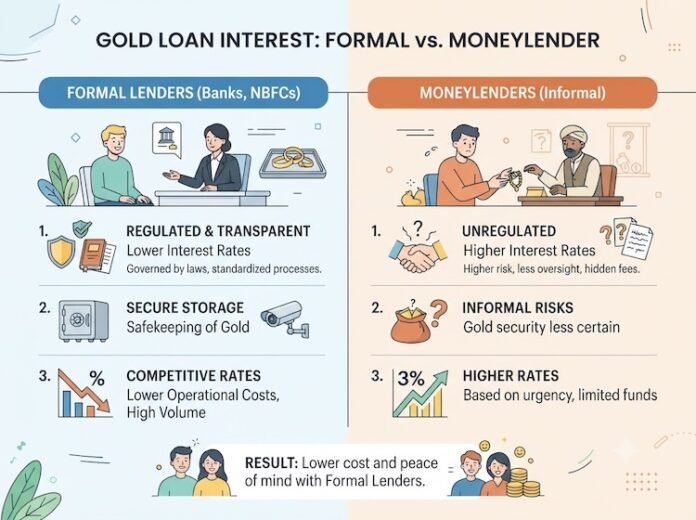

For generations, local moneylenders have supplied credit where bank branches, documentation and formal financial records were limited. Their familiarity with borrowers and flexible approach can make them accessible, particularly in rural or informal markets. That convenience, however, may come at a relatively high price.
Banks and regulated non-banking financial companies generally raise funds at lower institutional rates, process larger loan volumes and follow standardised collateral practices. These advantages can allow them to offer gold-backed credit at a lower interest cost than many informal lenders.
The difference isn’t universal, since moneylending rates and laws vary across states. Still, comparing the annual rate, fees and repayment terms often reveals a meaningful cost gap between regulated and informal borrowing.
Why Can Formal Lenders Offer Lower Interest Rates?
The cost at which a lender obtains money has a direct bearing on the price charged to borrowers. Banks use deposits and permitted market borrowings, while NBFCs may raise funds through bank credit lines, bonds, debentures and other institutional sources. A regulated lender with a stable balance sheet and an established credit profile can typically obtain capital more cheaply than an individual moneylender.
Scale also matters. A bank or NBFC may process thousands of gold-backed accounts through a network of branches. Standardised valuation, documentation, technology and secure storage spread operating expenses across a large portfolio. A local lender handling fewer transactions may need to recover costs and earn a return from a smaller customer base.
A formal gold loan is secured by eligible gold jewellery, ornaments or permitted coins. This collateral can reduce potential loss for the lender, although it doesn’t remove the need to assess repayment capacity where required.
Formal pricing may reflect:
- institutional funding costs;
- branch and technology expenses;
- collateral valuation and custody;
- liquidity and capital requirements;
- credit and operational risk; and
- a margin determined under the lender’s approved policy.
An informal lender may price in greater uncertainty because the arrangement lacks standardised records, verification processes or access to lower-cost funding. The resulting rate can therefore be higher, though practices differ across markets.
Why Do Monthly Rates Make Informal Credit Look Cheaper?
Informal lenders often quote interest as a monthly percentage or a rupee amount rather than an annual rate. A figure such as 2% a month may sound modest beside a formal lender’s annual percentage. Multiplied across 12 months, however, it is equivalent to 24% a year before considering compounding, fees or other conditions.
The method used to calculate interest can widen the difference. Interest may be charged on the original principal even after partial repayments. It may also be deducted from the amount handed to the borrower while still being calculated on the full stated loan. In some arrangements, unpaid interest is added to principal, increasing the base on which future interest is charged.
Suppose a person borrows ₹1 lakh for six months. At an annual rate of 12%, simple interest would be approximately ₹6,000. At 2.5% a month, interest over the same period would be about ₹15,000 under a simple monthly calculation. Actual outcomes depend on the agreement, and this example doesn’t represent every lender.
The published gold loan interest rate should still be examined alongside:
- processing and valuation-related charges;
- annual percentage rate, or APR;
- interest-calculation method;
- repayment frequency;
- renewal conditions; and
- consequences of delayed payment.
A gold loan calculator may help translate different rates into a common rupee estimate. For an informal quotation, the borrower may first need to convert the monthly rate into an annual figure and identify whether interest is simple, reducing-balance or compounded.
Also Read: Eligibility and Documentation Required for a Gold Loan
How Does Regulation Improve Cost Transparency?
Formal lenders regulated by the Reserve Bank of India operate within disclosure, fair-practice and conduct frameworks. The RBI doesn’t prescribe one uniform rate for every gold-backed facility. Banks and NBFCs retain pricing discretion, subject to their policies and applicable rules. Yet the borrower must receive prescribed information about the actual rate, APR, repayment schedule and applicable charges.
The Key Facts Statement is important because it presents significant loan terms in a standardised form. APR provides a broader measure than the nominal rate by including interest and associated charges covered under the regulatory framework. This helps borrowers compare two formal offers using a more consistent basis.
The RBI’s Lending Against Gold and Silver Collateral Directions, applicable no later than April 1, 2026, add protections concerning:
- standardised assaying and valuation;
- the borrower’s presence during assaying;
- an assay certificate describing the collateral;
- disclosure of applicable charges;
- secure handling and storage;
- notice and transparency before auction;
- refund of auction surplus; and
- timely return of collateral after repayment.
These safeguards don’t eliminate borrowing costs, but they make the transaction easier to verify. A borrower has written evidence of the pledged items, assessed value, applicable rate and repayment obligations.
A gold loan app may allow access to statements, dues or repayment services, depending on the regulated lender. Digital access can improve recordkeeping, although the borrower should still retain the sanction letter, Key Facts Statement and collateral certificate.
Informal arrangements may be subject to state moneylending laws and other legal requirements. Their documentation and enforcement practices, however, can vary. Borrowers should not assume that every informal loan lacks legal protection, just as they should not assume that every formal offer is automatically inexpensive.
What Other Differences Matter Beyond Interest?
Price is central, but it isn’t the only consideration. Informal lenders may be located nearby, understand local income cycles and accept repayment patterns that formal systems don’t always offer. For some borrowers, these features explain continued reliance on them even when the stated rate is higher.
Formal lenders, on the other hand, generally provide documented valuation, defined repayment terms and established grievance channels. After full repayment or settlement, the RBI directions require regulated lenders to return pledged collateral on the same day or within a maximum of seven working days. Where delay beyond this period is attributable to the lender, compensation is payable as prescribed.
Auction safeguards are also relevant. A regulated lender must provide adequate notice before initiating an auction, follow a transparent process and inform the borrower about the proceeds and dues adjusted. Any surplus must be refunded within the specified period. These procedures reduce uncertainty around what happens after default, although the pledged gold can still be sold if dues remain unpaid and due process is followed.
Before comparing formal and informal options, a borrower may ask:
- What is the annualised interest rate?
- How is interest calculated after part-payment?
- Are any amounts deducted before disbursal?
- What fees apply at sanction, renewal or closure?
- Is a written receipt issued for the gold?
- What notice is provided before sale or auction?
- How and when will the collateral be returned?
- Where can a complaint be raised?
The lowest quoted number may not provide the lowest effective cost if the calculation method, deductions or repayment conditions are unclear.
Conclusion
Formal lenders can often price gold-backed credit more competitively because they have access to institutional funding, scale and standardised operating systems. Their loans also come within regulatory frameworks covering disclosures, valuation, custody and enforcement. Informal moneylenders may offer local accessibility and flexibility, but their monthly rates can translate into a substantially higher annual cost.
The fairest comparison converts every offer into an annual rate and includes fees, calculation methods and repayment conditions. Written terms matter. They show not only how much the borrower will pay, but also how the pledged gold will be valued, protected and returned.